Danielle Groeneweg

Renting vs Buying- Accumulating Wealth

A recent Forbes blog titled, “How Do Homeowners Accumulate Wealth” written by Lawrence Yun was just recently published. I find that so many people wonder if buying is better than renting in the long run or how soon they should really purchase a home to be better off in life. Yun does a very good job of describing one of the key elements that buying a home offers-net-worth. It’s amazing the difference in net worth between a home owner and a renter. Please read on to learn one of the basic reasons why I always promote purchasing a home over renting.

Article was taken from here:

The differences between buying and renting are massive.  According to the Federal Reserve, a typical homeowner’s net worth was $195,400, while that of renter’s was $5,400.  The data reflects 2013 and the next survey of household finances, which is conducted every three years, will be out in 2016.  Based on what has happened since 2013 and projecting a conservative assumption of what could happen next year to home prices if we see only 3% price growth, the wealth gap between homeowners and renters will widen even further. The Fed is likely to show a figure of $225,000 to $230,000 in median net worth for homeowners in 2016 and around $5,000 for renters. That is, a typical homeowner will be ahead of a typical renter by a multiple of 45 on a lifetime financial achievement scale.

Though there will always be discussion about whether to buy or rent, or whether the stock market offers a bigger return than real estate, the reality is that homeowners steadily build wealth.  The simplest math shouldn’t be overlooked. A vast majority of homebuyers take out a 30-year fixed rate mortgage to make a home purchase. After 30 years, there is no mortgage payment (nor rent payment). So the home price growth over that time period would be the equity that the homebuyer would have accumulated. For example, the median home price of a single-family dwelling in the U.S. thirty years ago in 1985 was $75,500. This year, it will be at least $220,000. That figure of $220,000 is the housing component of the person’s wealth. Even had home prices not risen, the person would still have $75,500 in wealth today – on top of not paying any further monthly mortgage after 30 years.

This simple example does not play out nearly as neatly in the real world, since people do not stay in one residence over the 30 year period. Almost all homeowners trade up, change neighborhoods, or move to a better school district at some point. However, they are able to make those residential relocations due to the housing equity accumulated, even over a shorter period, and can immediately apply that equity to the next home as a downpayment. Therefore the conditions of steadily building housing wealth still hold.

We also know that not everyone can or should be homeowners. The memories of easily accessible subprime mortgages and subsequent harsh foreclosure pains are still fresh, and remind us of the devastating impact on the families involved, local communities, and to the broad economy. In addition most young adults have not developed the financial standing or have found a stable, desirable career and, therefore, choose not be homeowners until later.  The homeownership rate among households under the age of 35 is 35% currently and rarely rises above 40% historically. For those under the age of 25, the current ownership rate is 23% and rarely rises above 25%. But the time will eventually come when people want to convert to ownership. By the time people are in their prime-earning years of 45-to-55, nearly three-fourths do eventually become homeowners. By retirement, nearly 80% are homeowners.

A recent survey of consumers commissioned by my organization revealed that 80% believe that purchasing a home is a good financial decision (2015 National Housing Pulse Survey). Most consumers appear to already understand the simple math and the benefits of homeownership. So don’t overthink the matter of whether now is a good time to buy, or whether stock market returns will be better. The exact timing of a home purchase will have little financial impact in the big scheme of things. Just know that homeowners generally do come out ahead of renters in the long run.

If you are currently renting and have decided is finally time to start working on your net worth and you would like to do so in real estate, please give me a call.

Thanks for reading,

Danielle
Engaging a Buyer

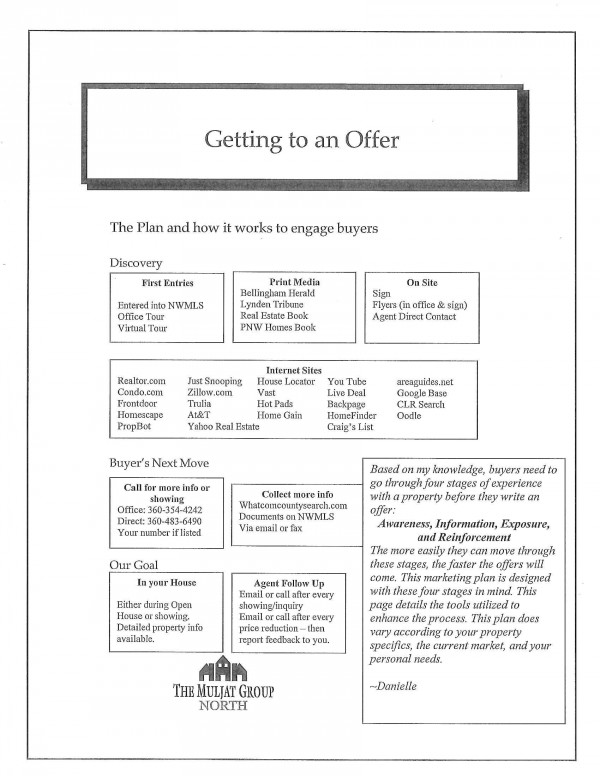
I have included my page from my sellers binder that is titled “Getting an Offer”.  As it says on this page, buyers need to go through four stages of experience before they write an offer (in most cases). The four stages include: Awareness, Information, Exposure and Reinforcement.  Read on to see how when I list a home I make sure a buyer can discover the home easily therefor they can complete the awareness and information stage. They can then go on to view home in person and get the exposure needed. Finally, they just need reinforcement and making sure it is the correct home for them which is done through communication.getting-an-offer-600x776
Please let me know if you have any questions or if you would like to know what I would do specifically for your home.

Thanks for reading,
Danielle

Utilizing Statistics when Selling

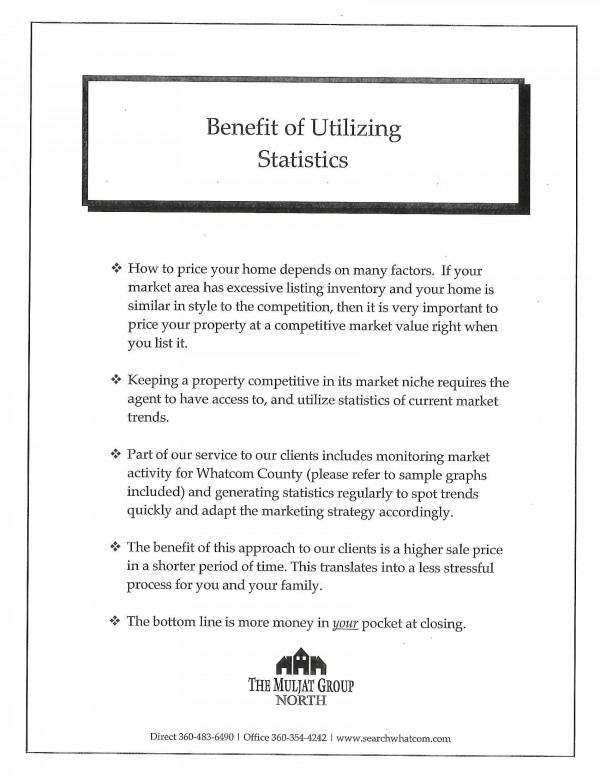
I have included 1 page from my listing packet that discusses the Benefits of Utilizing Statistics. There are many ways to decide what price you should list your home at. I hope by reading this document you feel a little more comfortable with how your agent should be getting their pricing. I promise it isn’t from thin air.The use of statistics as well as having knowledge about the current market, the area your home is located at and the specific needs that you have as sellers are all factors when it comes to choosing the initial list price. The initial list price is so important because it can really factor into your days on market as a seller. It’s very important to get the price correct the first time!20150925113401125_0001-copy-600x776
If you are interested in seeing what price I would come up with for your home or would like my full listing packet don’t hesitate to contact me.

Thanks for reading,

Danielle

Buyer’s Outline of Events

I just wanted to share an outline of events for buyers that I give to all of my clients. It’s a list that I created myself to help out either first time buyers or someone who has bought a home awhile ago and just needs a refresher. Enjoy ☺

Buyer’s Outline of Events

  • If you haven’t already, you should first meet with a lender to get a pre approval letter and determine what your purchasing options are
  • Work with your Realtor to search for the property of your dreams. Your Realtor can set up an automatic search for you online and send you listings as soon as they come on the market and you can also search for homes online by yourself. I always encourage my clients to do a drive by anylistings they are interested in so that they can get a feel for the neighborhood and then they can call to schedule an appointment to see it
  • Offer on the home you decide is right for you. Your offer may be countered, accepted or rejected if unreasonable
  • Once Mutual Acceptance is received: You have 2 days to deliver your earnest money check to escrow agent. You usually have 10 day to have your home inspection conducted. Keep in mind that if this is a short sale, none of the contingencies begin until bank approval has been obtained
  • After inspection is satisfactory, your bank will order an appraisal of the property.
  • You should begin to shop for home owner’s insurance policy. (usually good to start with the company you have car or rental insurance with)
  • You will continually be in contact with your lender and Realtor to receive updates and be advised if anything else is needed from you
  • Within about 1-3 days of the close date, the escrow agent should call you to schedule a signing of closing docs. (this can’t be scheduled until the escrow agent receives your lender’s docs for you to sign)
  • When you have your sign date, you should call utility companies to arrange for services to be put in your name as of the close date
  • Sales typically close within 24 hours of both parties signing. (unless over a weekend or holiday)
  • Your Realtor will call you to schedule a time to meet at your NEW HOME to get your keys!

Congratulations You’ve Bought a Home!!

I hope this outline clears up some of the steps involved. Buying a home can be tricky, most people only buy 1 or 2 in their lifetime. Lucky for you, it is something that I am involved with every single day. If you would like my complete buyer’s packet feel free to let me know. I would love to get you a copy. I’m also available to answer any questions.

Thanks for reading,

Danielle

Remembering 911

2013-08-19-baker_911_1-600x267
(photo taken from :http://www.huffingtonpost.com/kevin-obrien/911-virtual-career-fair-f_b_3780175.html)

I hope everyone can take some time today think about what happened 14 years ago and reflect. I know this day has so many different meanings and memories for us all. Some people may remember exactly where they were when they heard about the tragedy, others glued to their tv screens just watching the news. Either way, September 11, 2001 is a day to remember.

Thanks for reading,

Danielle

New to Whatcom County?

whatcom-co-numbers-mine-600x776

Are you new to Whatcom County? Here is a quick list I put together for my buyers that has lots of different phone numbers for local companies that you need if you just moved . Not sure what garbage company to call- it’s on here. Same with different cable companies, city halls and even propane providers.

If  you are interested in getting my full buyer’s packet-let me know! I hope you find this list helpful in the meantime, especially if you just moved!

Thanks for reading,
Danielle

Back to School

backtoschool-600x450

In honor of Back to School season I just wanted to give away a quick source for schools in Whatcom County. I ran across this great website that lets you pick a school district and learn more about it. Feel free to click here to check it out!

Best of luck on the upcoming school year and I hope everyone was able to enjoy the summer; especially with the awesome weather we had.

Thanks for reading,
Danielle

Current Market Stats

I just wanted to give a quick reminder about a service I provide on my website. If you are every wondering what the current market looks like through out Whatcom County make sure to take a look here. I have it set on the Lynden market but you can change the area of which you would like to focus on. Down below I do have examples taken from today of the current market stats in Lynden.

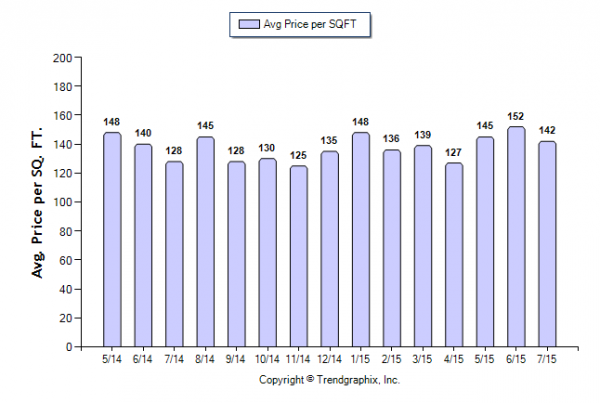
The first graph illustrates the market trends in Lynden in regards to Active, Sold and Pended properties for the last year. The second graph shows the average sale price variation in the last year.current-lynden-stats-600x403

current-lynden-stats-2-600x403These stats help decide what type of market we are currently having and any trends that are occurring. If you would like more information or have any questions don’t hesitate to ask.

Thanks for reading,
Danielle

Five Easy DIY’s to Increase Home Value

I ran across this great list of five easy DIY’s that will increase your home worth. Author, Melissa Dittmann Tracey, REALTOR® Magazine, even writes what she thinks the ROI will be per each project. Article was taken from here.

“It doesn’t have to cost a fortune to improve a home and make it more sellable, according to HomeGain’s 2012 National Home Improvement Survey.

HomeGain surveyed nearly 500 real estate professionals nationwide to determine the top do-it-yourself home improvement projects that offers some of the biggest bang for your buck when selling a home.

“In a buyer’s market, sellers need to dress their homes for success before putting them on the market,” says Louis Cammarosano, HomeGain’s general manager. The survey shows “that do-it-yourself home improvements like cleaning and de-cluttering and lightening and brightening your home are cost-effective ways of increasing your chances of selling faster and closing closer to the asking price than homes rushed to the market with no improvements.”

Here are the top five projects that real estate professional recommend to their clients–projects that have the potential to offer some of the highest returns on investment at resale, according to the 2012 HomeGain survey:

1. Clean and declutter

What to do: “Removing personal items; wash and clean all areas of inside and outside of house; freshen air; remove clutter from furniture, counters, and all areas of the home; organize closets; polish woodwork and mirrors.”

Estimated cost: $402

Potential ROI: 403% or $2,024 to the home’s sale price

2. Lighten and brighten

What to do: “Open windows; clean windows and skylights inside and outside; replace old curtains or removing curtains; remove other obstacles from windows blocking light; repair lighting fixtures; make sure window open easily.”

Estimated cost: $424

Potential ROI: 299% or $1,690

3. Repair electrical and plumbing

What to do: “Update leaky or old faucet spouts and handles; repair leaks under bathroom or kitchen sinks; laundry room pipes; toilets should be in good working condition; remove mildew stains.

“Update electrical with new wiring for modern appliances and/or Internet and other audio/visual equipment requested in homes today; door bell should work; service sprinkler systems; fix lights and outlets that do not turn on; replace old plug points with new safety fixtures.”

Estimated cost: $808

Potential ROI: 293% or $3,175

4. Landscaping

What to do: “Front and back yards; add bark mulch; rake and remove leaves, branches and debris; plant bushes and flowers; add planters and hanging plants; mow grass; water lawn and plants; remove weeds and dead plants; manicure existing plants; any yardwork that improves the curb appeal of a home.”

Estimated cost: $564

ROI: 215% or $1,777

5. Staging

What to do: “Add fresh flowers; removing personal items; reduce clutter; rearrange furniture; add new props or furniture to enhance room/s; play soft music; hang artwork in walls.”

Estimated cost: $724

ROI: 196% or $2,145

However, the survey finds that the home improvement projects that offer the highest potential price increase to a home’s resale value continues to be updating the kitchen and bathroom. Home sellers could potentially see a $3,255 price increase to their home at resale by tackling kitchen and bathroom projects, according to the HomeGain survey. ”

These five DIY’s could make a big difference in a potential buyers first impression of your home. When you live in a home everyday it is very easy to over look certain items and there is where I come in. I always offer to do a walk though with any seller and give them some ideas on sprucing up their home for a quick sale.

Feel free to give me a call if you are thinking about selling soon. I would love to give you ideas for simple DIY’s that increase your home value.

Thanks for reading,

Danielle

“Why No Two CMA’s are Ever the Same”

I ran across this article the sums up how lots of agents come up with different CMA’s when you are looking at selling your home and what your list price should be. This article is written by, Blanche Evans and found on realtytimes.com. To view the whole article click here.

Why No Two CMAs Are Ever The Same

“When you interview real estate agents to choose which one to list your home, each of them may each give you a snapshot of the local market known as the competitive or comparative market analysis or CMA. The first thing you notice is that the CMAs are all different and that the suggested listing prices can vary by thousands of dollars.

Is it that the real estate professionals don’t know what they’re doing? Not necessarily, but a few may be dumb like foxes. Some agents will cast a deliberately wide net in a CMA to get you to list at a lower price so the home will sell quickly. They could also use large parameters if they’re unfamiliar with the neighborhood you want to help them get your listing. What you want are homes within a few streets of yours, not the whole zip code.

CMAs are generated from multiple listing service software. They are only as accurate as the search criteria. If an agent puts in an entire zip code, the results are going to be quite different from a two-block radius. So take a good look at the area parameters.

Market conditions are what CMAs report. They’re composed of property listings, sales and pending home sales for the purpose of helping buyers and sellers understand the marketplace better.

Buyers use CMAs to help them make the lowest offers possible and still get the homes they want. Sellers use CMAs to help them choose a listing price so their homes will sell quickly and for the highest dollar possible. They use comparisons that are supposed to be based on the most similar homes available, using size, age, features, amenities, condition and location.

Even so, the selected properties can vary greatly depending on the search parameters used by the real estate professional. These can include the type of home (detached vs. attached), the name of the street, number of bedrooms, baths and living areas, square footage, and numerous other fields of information. The CMAs also tell you which homes have recently sold – six months, three months, one month, and which homes are currently on the market in the area and within the price range you’re interested in.

As many fields of information as there are, some criteria simply can’t be listed in a CMA. If the MLS has a field for “ocean views,” you’ll know. But if not, you’ll have to learn more in the remarks section that is filled in by the listing agent or simply sort through the listing videos and photos.

CMAs results may vary even between identical homes. One property may simply offer better drive-up appeal or is in better condition than the other, and that will be reflected in the sales price.

Sellers should know that there is one major thing that can’t be quantified – buyer and seller motivation. You don’t know why a seller agreed to take less for their home or why a buyer overpaid for another home. Family problems, corporate relocations and other reasons all play a role.

What you can learn from the CMA is how long the home took to sell. If it was quick, the seller was highly motivated. If it didn’t, it was probably overpriced, in poor condition, or in a bad location.

Your real estate professional will suggest a pricing strategy for you based on the CMA, but the asking price will be up to you.”

A couple things that I want to mention:

1) Make sure you are using an agent that is familiar with the area. It’s important for an agent to know the differences even inside of your own neighborhood. This will ensure that your home is going to be priced correctly and hopefully sell sooner.

2) As Evans mentions, check the parameters that your agent used when finding comparable homes. You might know more information on homes that have recently sold nearby than what your agent has access to.

If you are thinking about selling your home please give me a call. I would love to help you sell your home and make sure it is priced correctly!

Thanks for reading,

Danielle