Danielle Groeneweg

My Zillow Profile

zillow

I just wanted to share quick update from my end. I have recently become more active on Zillow. I know many of you are familiar with Zillow when looking at homes to buy, there famous Zestimates and etc. If you are on there already, I would love for you to take the time and check out my profile here.  On my profile you can learn more about me, check out my past sales and read some honest reviews of clients I have worked with in the past. Let me know what you think!

Thanks for reading,

Danielle.

Do You Think You Can’t Buy a Home?

Have you convinced yourself of a million reasons why you can’t buy a home or it just isn’t the correct time to do so? I ran across this great article on realtor.com titled, ” Top 6 Reasons to Not Buy a Home-Debunked” written by Margert Heidenry. Heidenry does a great addressing a lot of common fears and concerns as to why someone feels they can’t purchase a home. Although all 6 reasons are good and should be an area of concern when considering purchasing a home they are often times NOT true.

Please read the article below and see if any of these reasons sound familiar to you. Full article can be found here.

“You? Buy a home? If that prospect sounds as unlikely as your becoming the next U.S. president—well, this campaign season has shown us that anything can happen.

Sure, amassing the funds and slogging through the necessary paperwork for your own piece of the real estate pie can be daunting, especially if you’re a less-than-stellar loan candidate. Still, if you just assume there’s no way you could buy a home, without doing any research, you could be missing out.

Here are some oft-cited reasons people don’t buy a home, and the reality checks showing why they shouldn’t give up hope.

Reason No. 1: ‘I don’t have enough money for a down payment’

This is probably the most common justification for not making the leap into homeownership. After all, few people have a huge chunk of cash lying around—and you need 20% down to buy a home, right? Wrong.

“Needing a 20% down payment has lingered as a myth for years and causes many potential home buyers, including those in the millennial generation, to miss out on getting into a home,” says Christina Bartning with National MI, a private mortgage insurer in Emeryville, CA.

AJ Smith, a personal finance expert at SmartAsset, points out that with a loan backed by the Federal Housing Administration or Department of Veterans Affairs, you can usually get by with a down payment of 3% to 5%.

In addition, “grants are an excellent way for young buyers with good credit and stable employment to subsidize their down payment,” says Realtor® Mike Murray of the Murray Home Team at Coldwell Banker in Annapolis, MD. “These can typically be obtained by taking homeownership courses or purchasing in designated community development areas.”

However, if you do put down less, keep in mind you’ll need private mortgage insurance until you pay down the loan to the 20% threshold.

Reason No. 2: ‘I can’t afford a mortgage payment’

“Some people don’t realize the amount they pay in rent is more than if they had a mortgage,” says Realtor Kenneth Cagan of the Cagan Team in Coral Springs, FL. “Landlords are trying to recoup their taxes, insurance, maintenance fees and still make a profit. When you buy, you’re investing in yourself.”

To find out if renting or buying makes more sense in your neighborhood, try realtor.com‘s Rent vs. Buy Calculator.

For first-time buyers with low to moderate incomes, organizations such as Neighborhood Housing Services of Richmond have plenty of experience in helping.

“Laniesha, a young mother of two, gave us every excuse in the book as to why she couldn’t purchase a home, from ‘I don’t make enough money’ to ‘I am not married,’” says Samuel Robinson, NHSR’s marketing and public relations officer. “After explaining that none of these issues could stop her, we worked with Laniesha to pay off her debts and raise her credit score. She’ll be purchasing her new home in 2016.”

Reason No. 3: ‘I don’t have good enough credit history to get a mortgage’

So you’ve made some late payments, or have other skeletons in your past that have dinged your credit score. That doesn’t put a mortgage out of reach.

“If you’ve paid down your credit cards and kept a steady job, your application may be approved,” says SmartAsset’s Smith. “Potential home buyers with bad credit can also explore options like lease-to-buy programs, financing through the seller, and loans from private lenders.”

Get this: Some private mortgage insurance programs allow for credit scores as low as 620, Smith says.

Meanwhile, you can slowly improve your credit score by paying your bills on time and keeping your balances and inquiries low, says Murray. A licensed loan officer should be able to set up a one-year outline to get your credit on track.

But there’s one substantial caveat: Typically, mortgages for people with a lower credit score do come with a higher mortgage rate. And a very low score may require a higher down payment.

Reason No. 4: ‘I don’t have any credit history at all’

Even without a credit card, there are ways to build credit history, says Anne Postic of Mortgages.com.

“If you’re a renter, ask your landlord about reporting your payments to establish a history. Experian makes it easy for your landlord to report your payments, or for you to do it yourself.”

Reason No. 5: ‘I haven’t been at my job long enough’

“Work history is important,” says Jeremy David Schachter with Pinnacle Capital Mortgage in Phoenix AZ. “But even if you recently changed jobs and have only been there for a month, you can get qualified depending on your income and field.” A letter from your boss or place of employment will go a long way, so be sure to ask if you fear your relatively brief employment history might be an issue.

Reason No. 6: ‘I can’t find a home I like in my price range’

“People often think they have to buy their last home first,” says Fort Myers, FL, Realtor Angeline Sackett. But making a dream home a reality takes time. After all, they call first homes “starters” for a reason, right?”

If you have been debating starting to look for a home or looking into getting financed, please give me a call or email. I would love to go over your questions and concerns and see what type of options are out there for you.

Thanks for reading,

Danielle

What is a Realtor?

index

The “R” is a symbol most people recognize and for good reason. The National Association of Realtor is an amazing organization that was founded in 1908. I just wanted to take the time and point out that not all Real Estate Agents are Realtors.

Realtors are held to a higher standard ethically and professionally. I got this info below directly from the National Association of Realtors website. I thought it was a great read to give  you a few more facts about the NAR. For more info click here.
“NAR at a Glance

What: The National Association of REALTORS®, “The Voice for Real Estate,” is America’s largest trade association, representing 1 million members, including NAR’s institutes, societies and councils, involved in all aspects of the residential and commercial real estate industries.

Who: Our membership is composed of residential and commercial REALTORS®, who are brokers, salespeople, property managers, appraisers, counselors and others engaged in all aspects of the real estate industry. Members belong to one or more of some 1,400 local associations/boards and 54 state and territory associations of REALTORS®, or to one of 81 cooperating associations in nearly 60 countries. They are pledged to a strict Code of Ethics and Standards of Practice.

Why: Working for America’s property owners, the National Association provides a facility for professional development, research and exchange of information among its members and to the public and government for the purpose of preserving the free enterprise system and the right to own real property.
The Term REALTOR®

The term REALTOR® is a registered collective membership mark that identifies a real estate professional who is a member of the National Association of REALTORS® and subscribes to its strict Code of Ethics.”

Next time you are out shopping for a broker I highly suggest making sure they are also a Realtor. I am a Realtor and I also have the privilege to serve on the local Whatcom County Association of Realtors board.

Thanks for reading

North Prairie Cottages Open House

houses-road-pic-600x264

Two Open Houses This Weekend!!

Please stop by either Saturday February 20 from 10-12

OR

Sunday February 21 from 2-4.

Check out www.thenorthprairiecottages.com for more information on the FOUR different house plans and what different options are available as well as more interior pictures.

Feel free to call my cell: 360.483.6490 if you have any questions or need directions.

Six Reasons to Use a Realtor

I ran across this article on Realtor.com that I think is an excellent read. It gives you six reasons why you should use a Realtor. Buying a home is a huge task that you might do 2-3 times in your lifetime. Why don’t you use the knowledge and expertise of someone who goes through the home buying process everyday? Yes, you can do it on your own but why should you? Below is the article which is written by Rachel Stults and taken from here.

It’s a slow Sunday morning. You’ve just brewed your Nespresso and popped open your laptop to check out the latest home listings before you hit the road for a day of open houses.

You’re DIYing this real estate thing, and you think you’re doing pretty well—after all, any info you might need is at your fingertips online, right? That and your own sterling judgment.

Oh, dear home buyer (or seller!)—we know you can do it on your own. But you really, really shouldn’t. This is likely the biggest financial decision of your entire life, and you need a Realtor® if you want to do it right. Here’s why.

1. They have loads of expertise

Want to check the MLS for a 4B/2B with EIK and a W/D? Real estate has its own language, full of acronyms and semi-arcane jargon, and your Realtor is trained to speak that language fluently.Plus, buying or selling a home usually requires dozens of forms, reports, disclosures, and other technical documents. Realtors have the expertise to help you prepare a killer deal—while avoiding delays or costly mistakes that can seriously mess you up.

2. They have turbocharged searching power

The Internet is awesome. You can find almost anything—anything! And with online real estate listing sites such as yours truly, you can find up-to-date home listings on your own, any time you want. But guess what? Realtors have access to even more listings. Sometimes properties are available but not actively advertised. A Realtor can help you find those hidden gems. Plus, a good local Realtor is going to know the search area way better than you ever could. Have your eye on a particular neighborhood, but it’s just out of your price range? Your Realtor is equipped to know the ins and outs of every neighborhood, so she can direct you toward a home in your price range that you may have overlooked.

3. They have bullish negotiating chops

Any time you buy or sell a home, you’re going to encounter negotiations—and as today’s housing market heats up, those negotiations are more likely than ever to get a little heated.

You can expect lots of competition, cutthroat tactics, all-cash offers, and bidding wars. Don’t you want a savvy and professional negotiator on your side to seal the best deal for you?

And it’s not just about how much money you end up spending or netting. A Realtor will help draw up a purchase agreement that allows enough time for inspections, contingencies, and anything else that’s crucial to your particular needs.

4. They’re connected to everyone

Realtors might not know everything, but they make it their mission to know just about everyone who can possibly help in the process of buying or selling a home. Mortgage brokers, real estate attorneys, home inspectors, home stagers, interior designers—the list goes on—and they’re all in your Realtor’s network. Use them.

5. They adhere to a strict code of ethics

Not every real estate agent is a Realtor, who is a licensed real estate salesperson who belongs to the National Association of Realtors®, the largest trade group in the country.

What difference does it make? Realtors are held to a higher ethical standard than licensed agents and must adhere to a Code of Ethics.

6. They’re your sage parent/data analyst/therapist—all rolled into one

The thing about Realtors: They wear a lot of different hats. Sure, they’re salespeople, but they actually do a whole heck of a lot to earn their commission. They’re constantly driving around, checking out listings for you. They spend their own money on marketing your home (if you’re selling). They’re researching comps to make sure you’re getting the best deal.

And, of course, they’re working for you at nearly all hours of the day and night—whether you need more info on a home or just someone to talk to in order to feel at ease with the offer you just put in. This is the biggest financial (and possibly emotional) decision of your life, and guiding you through it isn’t a responsibility Realtors take lightly.

If you have been trying to do this process on your own, please let me help you! The home buying process should be exciting and not stressful for you. Let me take that burden off your shoulders and help you through the entire purchase from start to finish.

Thanks for reading.

My Process for Sellers

Are you thinking about putting your home on the market but aren’t sure what to expect? I have included a list of some of the innovative marketing strategies that I implement for every listing. Of course, depending on the home there might be additional marketing I would do or changes I would make to this list depending on the home and home owners.

Staging Your Home:

One of the key factors to selling your home for more money is staging-making your home more appealing and inviting to the majority of potential Buyers. We’ll work together to determine the level of staging your home may need.

Online:

Today’s buyer is very tech savvy! Often they look for their new home online before they ever actually visit a home. I’ll showcase your home by using professional and eye catching marketing to maximize your home’s online presence. Additionally, your home  will be syndicated on my company website, personal website, and all our affiliated websites.

Photography:

Buyers want to see what your home looks like before they decide to visit. They need visual images in order to imagine themselves living there. To enhance the exposure of your home, I create an online album ( or virtual tour) of your home, showcasing all the best features, both inside and out. Detailed descriptions further catch a potential buyer’s attention to your home.

Yard Sign:

With my company sign in your yard, your listing will be associated with one of the most successful and regionally recognized real estate companies in our area. My personalized yard sign is placed in a manner to draw attention to your home, direct potential buyers to my website and to provide easy access to my professional flyers.

Property Flyers & Advertising:

Colorful flyers using premium paper will be designed for your property and placed on a stand inside your home as well as a flyer box outside your home. This allows potential buyers that drive by to have instant access to your property information, in addition to qualified buyers who are touring inside your home. First impressions are extremely important! Additionally, a wide variety of advertising will be implemented to put your home inf front of the larger group of potential buyers.

Networking:

My extensive network includes my database of contacts and qualified buyers, real estate investors the agents within my local company and community, plus the thousands of agents I have referral relationships with outside our region.

Still have questions?

Please give me a call on my cell: 360.483.6490 and I can go over any questions you may have and give you a better idea on what I would do for your home. I also have some great samples of professional photos, flyers, and more I would love to share with you.

Thanks for reading.

Santa Coming to Lynden…

bws_santa(photo taken from here)

Please join us Saturday December 12 from 12:00-3:00 to get your free picture with Santa!

Address: 505 Front St, Lynden, WA 98264

Please bring a gently used coat or toy in exchange for a free picture with Santa by Everlasting Photography. All donations will be used to give back to the local community.

Hope to see you there!!

How Much Does it Cost to Sell your Home?

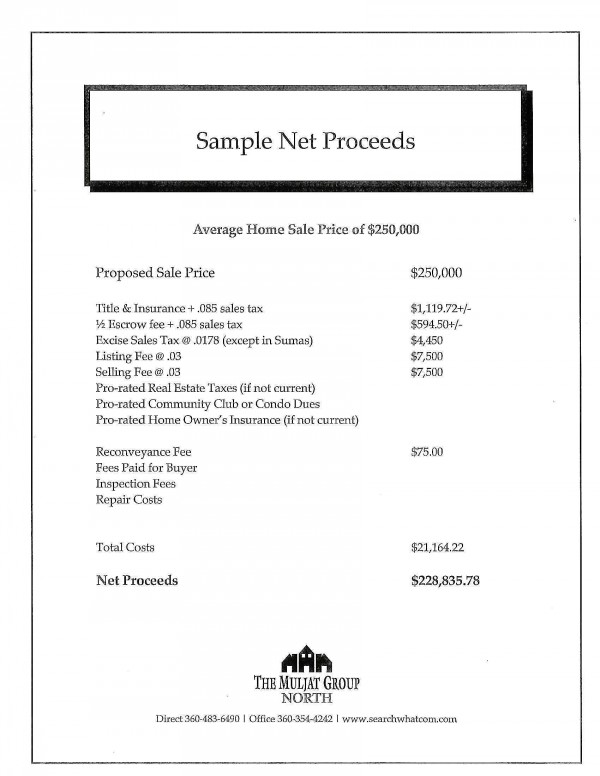
There are a lot of costs involved when trying to sell your home. Below, I have included a page from my sellers packet titled, “Sample Net Proceeds”. This is the costs based on a home that sold for $250,000. This is just an example, every home is different but this will give an idea of what some of the costs included might be.

Sample Net ProceedsIf you are curious about what the cost would be to sell your home please give me a call. I have a formula all set up on my computer that will help me calculate an estimate of what your net proceeds would be. Just need a few minor details. (No strings attached ☺)

Thanks for reading,

Danielle

Just a Couple Reviews

Since November is here and it is a month to be thankful, I wanted to share a couple recent reviews (with their permission of course) clients have given me. I just want to say how grateful I am for the amazing people I get to work with everyday.

All of these reviews are taken from my Redfin Page here: If you aren’t familiar with Redfin make sure to check out my page. You can also read more reviews and learn more about me and the services I provide for my clients.

“Danielle was extremely helpful and patient in guiding us through this transaction. There were some significant challenges due to the sellers using a relocation company and we currently live several hours away from where we purchased our new home, which makes everything more complicated. We would highly recommend Danielle to friends and family and are very thankful for her commitment to us and our new home.”

“Danielle was amazing. We are first time home buyers. She was so helpful and was able to answer all our questions. She made herself available to us at all times”

“We have been looking in Semiahmoo for over two years. This process, which Danielle was closely involved in each step included, looking at numerous homes, twenty plus at least, some as many as three times, made offers and counter offers on several, got within a few days of a closing on one, met with city and association folks to clarify local regulations, considered building, met with a builder and walked a number of lots. Then a house came on the market that Danielle, who by now knew our every like and dislike, immediately recognized that it would fill our needs. The net result is that we purchased it.

I do not know the number of hours that she put into the effort of finding us a house, but probably could be measured in weeks.

Having bought and sold many houses and properties over the last near fifty years, I can easily say that Danielle is most dedicated, and professional real estate representative we have ever dealt with. The firm that she works with is very fortunate to have her as an employee.”

Thanks so much for reading,

Danielle

Renting vs Buying- Accumulating Wealth

A recent Forbes blog titled, “How Do Homeowners Accumulate Wealth” written by Lawrence Yun was just recently published. I find that so many people wonder if buying is better than renting in the long run or how soon they should really purchase a home to be better off in life. Yun does a very good job of describing one of the key elements that buying a home offers-net-worth. It’s amazing the difference in net worth between a home owner and a renter. Please read on to learn one of the basic reasons why I always promote purchasing a home over renting.

Article was taken from here:

The differences between buying and renting are massive.  According to the Federal Reserve, a typical homeowner’s net worth was $195,400, while that of renter’s was $5,400.  The data reflects 2013 and the next survey of household finances, which is conducted every three years, will be out in 2016.  Based on what has happened since 2013 and projecting a conservative assumption of what could happen next year to home prices if we see only 3% price growth, the wealth gap between homeowners and renters will widen even further. The Fed is likely to show a figure of $225,000 to $230,000 in median net worth for homeowners in 2016 and around $5,000 for renters. That is, a typical homeowner will be ahead of a typical renter by a multiple of 45 on a lifetime financial achievement scale.

Though there will always be discussion about whether to buy or rent, or whether the stock market offers a bigger return than real estate, the reality is that homeowners steadily build wealth.  The simplest math shouldn’t be overlooked. A vast majority of homebuyers take out a 30-year fixed rate mortgage to make a home purchase. After 30 years, there is no mortgage payment (nor rent payment). So the home price growth over that time period would be the equity that the homebuyer would have accumulated. For example, the median home price of a single-family dwelling in the U.S. thirty years ago in 1985 was $75,500. This year, it will be at least $220,000. That figure of $220,000 is the housing component of the person’s wealth. Even had home prices not risen, the person would still have $75,500 in wealth today – on top of not paying any further monthly mortgage after 30 years.

This simple example does not play out nearly as neatly in the real world, since people do not stay in one residence over the 30 year period. Almost all homeowners trade up, change neighborhoods, or move to a better school district at some point. However, they are able to make those residential relocations due to the housing equity accumulated, even over a shorter period, and can immediately apply that equity to the next home as a downpayment. Therefore the conditions of steadily building housing wealth still hold.

We also know that not everyone can or should be homeowners. The memories of easily accessible subprime mortgages and subsequent harsh foreclosure pains are still fresh, and remind us of the devastating impact on the families involved, local communities, and to the broad economy. In addition most young adults have not developed the financial standing or have found a stable, desirable career and, therefore, choose not be homeowners until later.  The homeownership rate among households under the age of 35 is 35% currently and rarely rises above 40% historically. For those under the age of 25, the current ownership rate is 23% and rarely rises above 25%. But the time will eventually come when people want to convert to ownership. By the time people are in their prime-earning years of 45-to-55, nearly three-fourths do eventually become homeowners. By retirement, nearly 80% are homeowners.

A recent survey of consumers commissioned by my organization revealed that 80% believe that purchasing a home is a good financial decision (2015 National Housing Pulse Survey). Most consumers appear to already understand the simple math and the benefits of homeownership. So don’t overthink the matter of whether now is a good time to buy, or whether stock market returns will be better. The exact timing of a home purchase will have little financial impact in the big scheme of things. Just know that homeowners generally do come out ahead of renters in the long run.

If you are currently renting and have decided is finally time to start working on your net worth and you would like to do so in real estate, please give me a call.

Thanks for reading,

Danielle