Danielle Groeneweg

Staging Matters

I just wanted to share a couple Before & After Pictures on one of my most recent listings! Staging is such an essential part to any listing. It doesn’t matter if it is lived in, gorgeous home or an empty brand new construction! Just by clearing off counters, making the space bright & inviting as well as using a professional photographer can make all the difference! This is a service I provide to all of my clients. As well as hiring a professional photographer for pictures. I also stay during the duration of pictures to make sure we are getting the best angles & features of the home. All of this comes FREE to my customers.

Let me know what you think of these Before & Afters!

Olympics 2018


The Winter Olympics are finally in full swing! How many diehard fans do we have? Any specific events you HAVE to watch? I am SO in awe at how young & talented some of our athletes are. It’s amazing what can be accomplished when you have the RIGHT mindset.

If you’re wondering when some of the events are here is the Full Schedule.

ENJOY! & GO Team USA!!


Samples of BAD MLS Pictures

I ran across this article at Realtor.com that is showing some bad MLS Pictures that have been shared at Bad MLS Photos which is a Facebook group solely for Realtors & Photographers. You can access the full article here.

Honestly, some of this pictures are SO SHOCKING! Almost all buyers start their home search online which means the MLS pictures are the first impression buyers have about a home. I would be way too distracted by how TERRIBLE these pictures are to even want to take a look at the home.

As a Realtor, I want to offer the best services I can for my clients & help them get there home sold FAST & for TOP DOLLAR. That means hiring a professional, making sure the home is staged, clean & ready for pictures. Trust me, it makes a difference!! I have included some of the pictures below, let me know what ya think!


YES! Those were really used in the MLS to try and sell a home.

The article also went on to suggest a few tips for getting better pictures:

Reduce the clutter, close the toilet seat, get the junk out of the camera’s eye, make the bed.
Use the right hardware: tripod, wide-angle lens, and flash.
Carefully evaluate the lighting. It may require multiple trips to get the proper lighting based on the exterior light and the angle of the sun.
It’s OK to use photo editing software to highlight and correct lighting and color. Just don’t use it to misrepresent the home.
Be aware of seasonal changes. If you list your home with pics with snow on the ground, retake the photos when the snow disappears in spring.
Many times, the seller needs to list the property immediately and can’t get the house in proper shape for a few days. If you don’t have a lot of good photos when you first post the listing, go back and take additional photos as soon as possible afterward.


7 Small Homes Flaws That Can Be Big Deal for Buyers

I came across this great article from Realtor.com here. It does a great job of explaining just a few items that lots of Buyer’s will see right away when they walk into a home and might make them more hesitant to submit an offer. As a seller it is so important when listing your home to FIX all the minor things that you deal with everyday. It might be a sticky door, leaky faucet, ripped screen, burned out light bulb, etc. but to someone new coming into your home that can easily make them think, what else is wrong with this home or these home owners aren’t taking care of their property.So, read this article below & let me know what you think!

7 Small Home Flaws That Can Be Big Deals for Buyers

 | Jan 17, 2018

After living in the same home for a while, it’s amazing what you can get used to. A creaky floorboard, for instance. A chipped tile that you’ve been meaning to replace but haven’t gotten around to. A doorknob that needs a little coaxing to turn. No big deal, right?

Well, these small flaws can be huge deal breakers when you decide to sell your home.

“Prospective buyers are going to add all the ‘flaws’ they find to the price of the property, and that’s when they start trying to discount the price,” cautions Jane Peters, a real estate broker and owner of Home Jane Realty in Los Angeles.

Curious what some of these seemingly small problems are? Check out this list of minuscule (to you) things that buyers see as big hurdles to closing a sale.

1. An old electrical panel

Recently, home buyer made a controversial request for a repair at a property listed by Cedric Stewart, a real estate consultant at Keller Williams in the Washington, DC, area.

Apparently their home inspector claimed that $2,000 worth of repairs were needed on an electrical panel to get it “up to code.” The sellers insisted the current panel worked just fine.

“To the sellers, it was a small issue,” says Stewart, “but to the buyers, it was an electrical panel that could fail them at any time.”

To end this particular dispute, Stewart received bids from four electricians and got the repair quote knocked down to $1,200. The sellers offered that amount as a credit in lieu of repair at closing.

“The buyers grumbled,” Stewart recalls, “but they took it.”

2. Ripped window screens

Window screens will wear out over time, but if yours are torn, take it seriously.

“They’re a pain for anyone to replace,” says Stewart. “Therefore, sellers don’t want to do it and buyers will insist that they do. If the sellers refuse to fix it, the buyers will demand a credit. This can be a major point of contention, and we’ve seen it delay progress before.”

Stewart recalls one seller who agreed to replace a damaged window screen. But on the final walk-through, it still hadn’t been done—and the buyer threatened to walk away from the deal.

“It worked out,” says Stewart, “but it wasn’t pretty.”

3. The location of your laundry room

Even if you own a state-of-the-art washer and dryer—and plan to bestow both on your lucky buyers—they may not be so thrilled with these nice appliances if they aren’t situated in what they think is the “right” place.

“Some buyers have a problem with the laundry being on the ‘wrong’ level, especially in a three-level house or townhouse-style condo,” Peters explains.

In other words, you might be fine lugging your laundry to the basement, but don’t expect all buyers to feel the same way. Offer to move these items to a new locale to warm buyers up.

4. Sticky door locks

Live in a house long enough, and you’ll encounter a malfunctioning door latch or lock. That may be no big deal to you, but it may alarm buyers big-time.

If it’s an exterior door, they will likely view this as a major safety issue, explains Stewart. And although it may seem like a simple fix, it’s often a complex one, he says.

Think about it: The company that installed the doors may no longer be around, the model may not be in production anymore, and/or it could be tough to get someone to replace the exact hardware. Consider fixing this problem before a buyer notices it.

5. Your bathtub or shower

Some people prefer showers, others want baths (particularly parents who must clean up small kids). So if you’re missing one or the other, watch out.

In an ideal world, you’ll have both: a bath with a showerhead above. But even if your bathtub works just fine, make sure the style isn’t too off. Not everyone is excited to soak in a tub straight out of “Stranger Things” in avocado green. If that’s you, luckily there is an easy fix: Consider slapping on a new coat of paint (yes, you can do that).

6. Small closets

“Many buyers focus on closets,” says Peters. “Are there enough? Are they large enough? Walk-in closets are also preferred.”

There are a few things you can do to ease these concerns. For one, try to make your closets look roomier by decluttering them as much as possible. Put excess items elsewhere (like a rented storage unit). You might also consider hiring a contractor to build or extend closets where needed—or at least point out to buyers that they can do this themselves.

7. The walls of your kitchen

Some people like—no, make that love— open kitchens. So if your kitchen currently has four walls, you could be in trouble.

“Buyers may look at the possibility of breaking down a wall,” Peters says. But be warned, many might not want to do the work, or just get such a bad first impression of your kitchen that they move on. If you think your kitchen’s four walls feel cramped and is stalling your sale, consider opening it up yourself.

Sample of Net Proceeds


Have you been wondering just how much it costs to sell your home or how much money you would have to put into your next home? Here is an example I put together of Sample Net Proceeds. I would be more than happy to give you a personalized copy that applies to how much you could sell your home for.

Please give me a call if you want to see how this looks for your home @ 360-483-6490. If you want more information regarding selling your home also check out my Seller’s Page for lots of great tips on how to get your home prepared to sell as well as how the process works & what I provide for my clients.


Lynden Lighted Christmas Parade & More!

Do you already have your calendars marked for tomorrow in Lynden? So many exciting things happening in Downtown Lynden! Cross your fingers that the rain stays away!!


Here are just a few events going on tomorrow: For a FULL Schedule check out Lynden DBA Facebook Event here.

“- COMMUNITY BREAKFAST – Saturday Dec 2nd 8am to 10:30am at Lynden Community / Senior Center, 401 Grover Street. Enjoy all you can eat pancake breakfast before you start your day of shopping in Lynden. Breakfast cost is $6/$3.

– ELF ON THE SHELF SCAVENGER HUNT – NEW RULES THIS YEAR! More time to find the elves! We will have a kickoff event starting at 11am on Saturday December 2nd. We will collect entries through the month of December and the Elf on the Shelf will draw winners Live on Facebook! Winners will be drawn each week on Saturday Dec 2nd, Saturday Dec 9th, Saturday Dec 16th and Saturday Dec 23rd. Need not be present to win 🙂

– TINY TOT CHRISTMAS PARTY – Saturday Dec 2nd 10:30am to 12:30pm at Lynden Skateway, 421 Judson Street. $7 Admission. For more information, see Tiny tot Christmas Skate Party event page.

– VISIT WITH SINTERKLAAS – Saturday Dec 2nd 2pm to 4pm at The Inn at Lynden Front Lobby. FREE. Bring your camera for pictures.

– SPAGHETTI FEED – Saturday Dec 2nd 4pm to 7pm at Lynden Fire Department, 215 4th Street. FREE. By donation. For more information visit Lynden Firefighters Annual Spaghetti Dinner Fundraiser event page.

– LIGHTED CHRISTMAS PARADE – Saturday 6-7pm: Coordinated by the Lynden Chamber of Commerce. The Lighted Christmas Parade starts at 6pm at Fairway Center and travels down Front Street through downtown Lynden. Grab your jackets and chairs and watch a beautiful display of lighted trucks, cars, floats, wagons, farm equipment, and more! For additional information and parade applications, please contact the Lynden Chamber of Commerce by phone at 360.354.5995 or by email at events@lynden.org.”


Hope you are able to make it to some of these events on Saturday!

Different Architecture Styles

How well do you know different home architecture styles? Driving around through any new neighborhoods in Whatcom County you will definitely see the majority of Craftsman homes. Also, the “Ranch” style is vey common & well known.

I came across this article written by Seattle Modern Home Staging & thought they did a great job of describing different homes styles. (www.smhsdesgins.com) Some of these are more popular in the Seattle Area but you do come across them in Whatcom County as well.  Can you think of any homes you have seen that are these styles specifically?

“CRAFTSMAN STYLE
Craftsman bungalows are now very popular with preservationists and young homeowners wanting to restore a beautiful historic house back to its original splendor. Craftsman architecture was a reaction to the excessive, over-the-top ornamentation of the Victorian era. Dating the Craftsman Bungalow goes back to the Arts & Crafts movement in the 1900-1910.
When talking specifically about the actual design of Craftsman-style houses in the United States, the most common architectural details were inspired primarily by the work of two California architects — brothers Charles and Henry Greene. During the decade of 1900-1910, their architectural firm, Greene and Greene churned out dozens of landmark Craftsman homes.

PRAIRIE STYLE


Prairie Style is attributed to Frank Lloyd Wright. In 1893, Frank Lloyd Wright founded his architectural practice in Oak Park, a quiet village on the west edges of Chicago. It was at his studio during the 1910’s that Wright pioneered this a bold new approach to domestic architecture.

Prairie School style is usually marked by horizontal lines, flat or hipped roofs with broad overhanging eaves, windows grouped in horizontal bands, integration with the landscape, solid construction, craftsmanship, and discipline in the use of ornament. Popular in the Midwest.

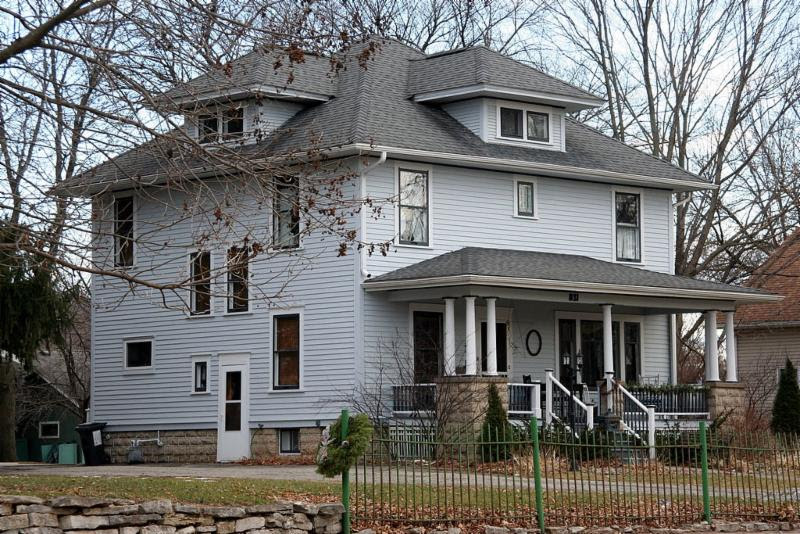
AMERICAN FOURSQUARE


Mid 1890’s-1930’s – The American Foursquare was plain, often incorporating handcrafted woodwork. This style incorporates elements of the Prairie School and the Craftsman styles.

Highlights of the style include a basically square, boxy design, two-and-one-half stories high, usually with four large, boxy rooms to a floor, a center dormer, and a large front porch with wide stairs, the box shape provides maximum interior room space, and small city lots to best advantage.
The Foursquare was a popular mail-order era style along with the California bungalow. When one was ordered, it came via train in a boxcar with a book of directions and all the parts pre-cut and numbered for self-assembly.

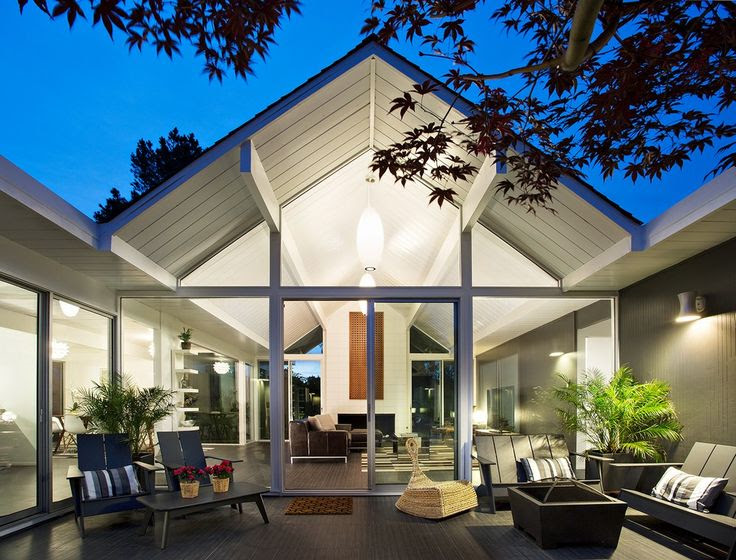
MIDCENTURY MODERN


Mid-century modern is a term that describes mid–20th century developments in interior, product, and graphic design, architecture, and urban development from roughly 1933 to 1965. Scandinavian architects were very influential at this time, with a style characterized by clean simplicity and integration with nature.
Like many of Wright’s designs, Mid-Century architecture was employed with the goal of bringing modernism into America’s post-war suburbs. This style emphasized ample windows and open floor plans, opening up interior spaces and bringing the outdoors in. Many Mid-century houses utilized post and beam architectural design that eliminated bulky support walls in favor of walls seemingly made of glass. Function was as important as form.
An emphasis was placed specifically on targeting the needs of the average American family. One of the most famous developers of the MidCentury Ranch Style home was Joseph Eichler . Eichler was instrumental in bringing Mid-Century Modern architecture (“Eichler Homes”) to subdivisions in the Los Angeles area and the San Francisco Bay region of California, and select housing developments on the east coast.

MODERN


Modern architecture or modernist architecture is a term applied to a group of styles of architecture which emerged in the first half of the 20th century and became dominant after World War II. It was based upon new technologies of construction, particularly the use of glass, steel and reinforced concrete; and upon a rejection of the traditional influential architects at the end of the 20th century are difficult to put into any one category or movement.

The notable end-of-century buildings of Richard Meier, Frank Gehry, and Ludwig Miles van nder Rohe, (shown pictured) are notable architects.

What to Ask After an Inspection

Nothing can be more frustrating than falling in love with a home only to have a BAD inspection report come back. It’s important to remember that a licensed inspector has to call out EVERYTHING they find. Some fixes are extremely small, for instance I have had the phrase, “plants are too close to the house” on several reports but I have also seen, “roof needs replaced” or “foundation is cracked”. So, if you get a list a mile long should you really ask for every item to be replaced?

Answer is: No. You don’t ever want to upset or annoy the sellers by asking for too much. At the same time, you don’t want to purchase a home with THOUSANDS of dollars needed in repairs. There is a happy medium or even a dollar price that you can ask the purchased price to be reduced to.

This article on Realtor.com does a great wait of explaining what you should ask for and what you shouldn’t.

Article is taken from here. 

“How to Negotiate Repairs After a Home Inspection: Haggling Tips for Buyers”

 | Oct 19, 2017

If you’re buying a home, you’ll want to know how to negotiate repairs after a home inspection. After all, odds are even the dreamiest house will have problems, and sellers might be open to the notion of fixing a few flaws—with the right persuasion.

So once your trusty home inspector scrutinizes this potential purchase and hands you his report, what should you say to the sellers from there? Look no further than this handy haggling guide for home buyers on how to negotiate repairs after a home inspection.

Pick your battles

While it’s tempting to start nickel-and-diming the sellers so that your new home can be as pristine as possible when you move in, that’s just not realistic, warns Realtor® Kyle Springer, with Coldwell Banker in Bowling Green, KY. Instead, he advises, “concentrate your time and attention on major, structural issues, rather than cosmetic ones

So if that cracked faceplate is bugging you, head to the hardware store and get another one for a few bucks rather than adding it to a long laundry list of repair requests—which will no doubt annoy the seller.

So which repairs fall into the “need” versus “want” categories?

Required repairs after a home inspection

Here are two of the Items a seller must fix:

  • Any water penetration issues such as a wet basement or moldy walls
  • Local code safety violations such as missing handrails or an unstable deck

If you have a mortgage, your lender will likely require certain repairs before handing over your loan. As such, certain repairs listed on the home’s appraisal report will have to be fixed, too.

Common home repairs to request (but you may not get)

Here are some common items on buyers’ home repair lists, although sellers may or may not be willing to fix them:

  • Upgrading ungrounded electrical wiring if the house was built before the 1960s
  • Replacing old-style galvanized water pipes or any leaking pipes
  • Making roof repairs
  • Changing disintegrating sewer pipes
  • Upgrading heating/cooling systems and water heaters

Back up your requests with research

It’s easy to eyeball a potential problem and say, “It looks like there’s been water damage” or “That roof is looking a little worn.” It’s quite another to have evidence on how extensive the damage is and an estimate of how much it will cost to fix. The more specifics and backup you can provide, the better.

This is why a home inspection is so important; it helps when sellers hear it from a pro. For example, telling the seller you want the porch repaired because it feels shaky will not hold weight unless a professional home inspector submits a report about the porch’s structural damage.

Ask for a repair credit

Rather than having the seller coordinate and pay for the work, ask for a “repair credit” instead.

Scott Brown, owner of Brightside Home Inspections in Syracuse, NY, recommends asking for a repair credit on any problem that’s more than $500. This is actually in the buyer’s favor, as the seller no longer has a vested interest in ensuring the job will be done right.

“Otherwise the home seller will almost always find the cheapest available contractor or family member to fix the problem,” says Brown. “Meanwhile, you as the buyer would, of course, prefer the best contractor available.”

Aviva Friedlander contributed to this story.

Trying to Sell Your Home By Yourself?

As a Realtor, I always have a hard time when I hear home owners thinking they can sell their home by themselves. Yes you can do it, but why do you want to? Yes we do charge you money to sell your home, but so does every other professional when you use their services. If you chose to use a professional, in the end chances are your home will sell for a higher price and it will sell much faster compared to trying to list yourself which ends up SAVING you money.

If you are thinking about trying to sell your home by yourself give me a call. I would love to go over the entire process with you and help you decide if it is something you want to tackle yourself or hire a professional for.